Sunday, September 21, 2008
Dhamma Audio Sermons of ven. Na Uyane Ariyadhamma Maha Thero
Visit http://www.sadaham.net/audio.html for audio sermons given by ven. Na Uyane Ariyadhamma Maha Thero


Monday, August 25, 2008
Sunday, August 24, 2008
Dhammaruwan story (Pirith chanting child)
 Some of my blog visitors are landed for searching "Dhammaruwan story" on Google. Couple of month ago I published some pirith files chanted by Dhammarunwan (from www.prith.org). But I didn't do much search for Dhammaruwan on the internet before publishing the pirith chanting files.Finally because of the curiosity I searched the web for keyword "Dhammaruwan story" and found the nice story behind him. Please visit following links if you are interesting to read about him and his current life.
[1]http://theravadin.wordpress.com/2008/08/09/chanting-in-the-6th-century/
[2]http://web.mac.com/nirodha1/Site/Dhammaruwan.html
Monday, July 28, 2008
venerable mahasi sayadaw
 The Ven. Mahasi Sayadaw of Myanmar can be considered as one of the most influential meditation masters of modern times.
Ven. Mahasi Sayadow is believe to be attended
Arashathship (Nibbana). He is the one who cleared the path and declare for the word about ancient meditation techniques used by forest monks.
During his lifetime the Ven. Mahasi Sayadaw was instrumental in establishing over 300 Mahasi meditation centers in Burma, all following his teachings. The Ven. Mahasi Sayadaw undertook many Dhamma missions to foreign countries during which he planted the seed of Dhamma. Among the countries he visited are India, Sri Lanka, Nepal, Singapore, Malaysia, Thailand, Vietnam, Cambodia, Laos, Indonesia, Japan and other Asian countries. His Dhamma missions also took him to North America and the United Kingdom, France (Tournon and Paris, 1979) and Holland. As a result, a keen interest in the Mahasi approach to Vipassana meditation developed and led to the establishment of numerous Mahasi meditation centers outside of Burma.
On 14 August, 1982, having spent 58 rains (vassa) as a Buddhist monk, the Ven. Mahasi Sayadaw at the age of 78 passed away. During a life selflessly devoted to the spread of the Dhamma he had helped thousands upon thousands onto the path of liberation.
Read more form hereMonday, July 21, 2008
Jathaka Katha Site
New site containing list of jathaka stories with pictures (Sinhala language). Seem to be a great effort by the site creators.
http://www.jathakakatha.org/
http://www.jathakakatha.org/
Tuesday, June 24, 2008


Friday, June 06, 2008
Lankapura Sariputta Thero
I read this story from dailynews site. I have heard some dhamma sermons given by Sariputta thero. Hoping to upload and publish those sermons though my blog. I also got to know that this thero has attend Arashathship (Nibbana) and he is guiding the lame people to nibbana though practical meditation. His dhamma talks revels the fact that, into what extend he has done the meditation. Surely he has done meditation until the final stage (Nibbana) . If any one interested Please visit this monk. Writer has mentioned some address in this letter, may be it will helpful to find this rare monk.
http://www.dailynews.lk/2006/12/05/main_Letters.asp
http://www.dailynews.lk/2006/12/05/main_Letters.asp
The monk who thinks out of the box
One day my sister said, "Nangi, I met a very peculiar monk. He teaches an even peculiar method of meditation, which when practised, makes one new' and she forced down the meditation method down my throat, to my utter dismay, for I was one who had been frustrated by practising the various methods of meditation which the modern meditation masters of the country proclaim to be leading to Nibbana.
With the greatest reluctance I started practising this 'peculiar' method of meditation of this peculiar monk. For sure, after every hour of meditation I became new and new and new. So, after nine hours of meditation, I thought of actually seeing this monk with my own eyes.
So I made the trip to Malabe with my sister and brother-in-law, for a meditation session with this monk. We reached no. 479, Bodhiya Road, Talahena, Malabe, by 8 O' clock. After signing the register we sat on the mats on the floor, cross legged.
There he sat, Sri Lankapura Sariputta Thera. He is a very unassuming monk with an air of light-heartedness and strength. He teaches this peculiar method of meditation after paying obeisance to the three Jewels.
He makes the devotees practise this method of meditation for one hour, and then gives a Dhamma talk. What fascinated me was the originality and the truth embedded in the Dhamma talk. After the Dhamma talk everyone gets a cup of 'plain' tea, and again the Dhamma talk continues.
At 12 noon, its time for 'dane'. Everyone partakes of a delicious meal distributed free of charge and at 1 O' clock the Dhamma discussion begins. After the Dhamma discussion, there is another hour of meditation and at 3 O' clock everyone gets the afternoon cup of tea, free of course.
After tea some of the devotees leave and some stay on for further clarification of the Dhamma. He is a very unorthodox monk who gives the key to Nibbana right away. you only have to practise diligently.
K. SUGATHADASA
Wednesday, May 28, 2008


Tuesday, April 15, 2008
Bana audio
One of my friend given this Bana.mp3 file to me. The audio track is modified by adding echo effect. Which is similar to ocean waves that goes up and down. One of our village Pirith master said the audio is mush similar to load buddha's Pirith chanting (I don't sure). Anyway it is worth to hear this audio. Please download the file from below link.
Monday, April 07, 2008
Rare Dhamma Sermons

Some of the rare Dhamama talks related to Samatha and Vipassana Meditation given by Most Venerable Matara Sri Gnanarama Maha Swamin Wahanse can be downloaded in MP3 format on the link below. Most Venerable Matara Sri Gnanarama Maha Swamin Wahanse was the first meditation master at Nissarana wanaya Meethirigala.
Link:
http://nissaranavanaya.blogspot.com
Friday, November 30, 2007
Best Pirith Chanting
One of my friend told me about this pirith chanting. At that time I was searching for this pirith chanting and amazed once I heard that I could download it though web. This is best Pirith chanting I have ever heard. Small boy called Dhammaruwan around two years of age did this chanting and his adopted and devoted Buddhist foster father did the recording. as the site says this chanting was done in original pali language , known only to a few scholar monks
1.Dhammachakka Suthra
2. Girimananda Suthra
3. Bhojjhanga Piritha
4.Maha Mangala, Rathana & Mettha Suthra
site : www.pirith.org
1.Dhammachakka Suthra
2. Girimananda Suthra
3. Bhojjhanga Piritha
4.Maha Mangala, Rathana & Mettha Suthra
site : www.pirith.org
Monday, May 28, 2007
A Spiritual Biography

Introduction:
Venerable Ãcariya Mun Bhýridatta Thera is a towering figure in contemporary Thai Buddhism. He was widely revered and respected during his lifetime for the extraordinary courage and determination he displayed in practicing the ascetic way of life and for his uncompromising strictness in teaching his many disciples. During the 50 years since his death, he has assumed an exalted status in Buddhist circles and thus remains an overshadowing presence whose life and teachings have become synonymous with the Buddha’s noble quest for self-transformation.
After reading biography of Ãcariya Mun Bhýridatta Thera I felt like Acariya thero has attained nibbana (Arashathship). So I will publish the URL to free e-book here.
Free e-book can be found at http://www.buddhanet.net/pdf_file/munbio_photos.pdf
Wednesday, May 16, 2007
Sadaham.Net
This is another Quality site with very rare Dhamma Audio Sermons. Sermons of Ven. Na Uyane Ariyadhamma Maha Thero are there.
Thursday, May 03, 2007


Sharmadana at Abayagiri Stupa

Stupa:
Rising to a height of about 320 feet, this is one of the most significant Buddhist monuments. Constructed by King Vattagamani Abhaya (Walagamba) in the 1st century BC, this is the second largest stupa in the world. The relics of the Buddha are said to have been enshrined in a figure of a bull made out of thick gold.
I got a chance to participate for a sharmadana at Abayagiri Stupa which I believe one of the unforgettable experiences of my life. Around 150 people were there in our team and the organizer name is “Janith”. IFS and some other companies were sponsored for this event.
People belong to different Religions such as Buddhist, Islam and Hindu were worked at there for this “SharmaDana”. What a difference. All of them are volunteer workers they worked not for money or anything. I felt that merit we have done by participating for this event is immeasurable.
Central Cultural Fund is giving support for this huge project. But that contribution is not enough since this project is not under government sponsorship. They need our help to carry out this project and make it successful.
This project is under need of human power (labor effort) and row materials like (Hubas meti, hunu, dahaiya, aguru). So anyone interested can give their support to this project by arranging sharmadana or giving funds/row materials for project.
I will post the contact numbers of responsible parties’ latter.
Wednesday, February 14, 2007
Barmiyan Buddha Replica At Pereliya


Pereliya was the place where 1000 of people got killed inside a train because of tsunami. Great to see that Barmiay buddha Replica at pereliya.
Tuesday, January 30, 2007
great site about buddhism
I found a very interesting site about buddhism.
http://www.beyondthenet.net/
http://www.beyondthenet.net/
Thursday, July 13, 2006
What is Buddhist Meditation
 There are many things in life that are beyond our control. However, it is possible to take responsibility for and to change one’s state of mind. According to Buddhism this is the most important thing we can do, and Buddhism teaches that it is the only real antidote to the anxiety, hatred, discontentedness, sleepiness, and confusion that beset the human condition.
Meditation is a means of transforming the mind. Buddhist meditation practices are techniques that encourage and develop concentration, clarity, and emotional positivity. By engaging with a particular meditation practice one learns the patterns and habits of the mind, and the practice offers a means to cultivate new, more positive ways of being. With discipline and patience these calm and focused states of mind can deepen into profoundly tranquil and energised states of mind. Such experiences can have a transformative effect and can lead to a new understanding of life.
Over the millennia countless meditation practices have been developed in the Buddhist tradition. All of them may be described as 'mind-trainings', but they take many different approaches. The foundation of all of them, however, is the cultivation of a calm and positive state of mind.
Each year thousands of people learn meditation with the FWBO. They learn two basic meditations that develop these qualities: the Mindfulness of Breathing and Loving-Kindness meditation or Mettabhavana.
Learning Meditation
The techniques of meditation are very simple. However, reading about them is no substitute for learning from an experienced and reliable teacher. A teacher will be able to offer you guidance in how to apply the technique and how to deal with difficulties. Perhaps most importantly, a teacher can offer the encouragement and inspiration of their own example.
 At FWBO Centres, meditation is taught by members of the Western Buddhist Order, who are experienced meditators. Classes and courses are open to everyone: you need not be interested in Buddhism. Motives for learning meditation vary. Some people want to improve their concentration for work, study, or sports; others are looking for calm and peace of mind. Then there are people trying to answer fundamental questions about life. With regular practice, meditation can help all of us to find what we are looking for.
Meditation Courses are excellent contexts for learning.
Retreats offer ideal conditions to go more deeply into meditation.
Preparation
When you sit down to meditate you need to set up your meditation posture in a way that is relaxed but upright, usually sitting on a cushion and probably cross-legged. If this is not easy you can sit kneeling or else in a chair. Then you close your eyes, relax, and tune in to how you are feeling. It is important to be sensitive to your experience because this is what you work with in meditation. It is a good idea to take some time to sit quietly before starting a meditation, to slow down and relax. Some gentle stretching can also help.
List of Meditation Centers
http://www.buddhanet.net/pdf_file/Sri-Lanka-laypeople-monasteries.pdf
Wednesday, July 12, 2006
Load Buddha and Buddhism
"Buddhan saranan gachchami"
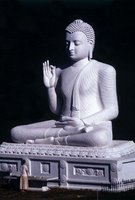 Buddhism is a path of practice and spiritual development leading to Insight into the true nature of life. Buddhist practices such as meditation are means of changing oneself in order to develop the qualities of awareness, kindness, and wisdom. The experience developed within the Buddhist tradition over thousands of years has created an incomparable resource for all those who wish to follow a path — a path which ultimately culminates in Enlightenment or Buddhahood.
 Because Buddhism does not include the idea of worshipping a creator god, some people do not see it as a religion in the normal, Western sense. The basic tenets of Buddhist teaching are straightforward and practical: nothing is fixed or permanent; actions have consequences; change is possible. Thus Buddhism addresses itself to all people irrespective of race, nationality, or gender. It teaches practical methods (such as meditation) which enable people to realise and utilise its teachings in order to transform their experience, to be fully responsible for their lives and to develop the qualities of Wisdom and Compassion.
There are around 350 million Buddhists and a growing number of them are Westerners. They follow many different forms of Buddhism, but all traditions are characterised by non-violence, lack of dogma, tolerance of differences, and, usually, by the practice of meditation .
 Buddhism is a path of practice and spiritual development leading to Insight into the true nature of life. Buddhist practices such as meditation are means of changing oneself in order to develop the qualities of awareness, kindness, and wisdom. The experience developed within the Buddhist tradition over thousands of years has created an incomparable resource for all those who wish to follow a path — a path which ultimately culminates in Enlightenment or Buddhahood.
 Because Buddhism does not include the idea of worshipping a creator god, some people do not see it as a religion in the normal, Western sense. The basic tenets of Buddhist teaching are straightforward and practical: nothing is fixed or permanent; actions have consequences; change is possible. Thus Buddhism addresses itself to all people irrespective of race, nationality, or gender. It teaches practical methods (such as meditation) which enable people to realise and utilise its teachings in order to transform their experience, to be fully responsible for their lives and to develop the qualities of Wisdom and Compassion.
There are around 350 million Buddhists and a growing number of them are Westerners. They follow many different forms of Buddhism, but all traditions are characterised by non-violence, lack of dogma, tolerance of differences, and, usually, by the practice of meditation .
Monday, May 29, 2006
Jathika Namal Uyana-The Largest Pink Quartz Mountain in South Asia
(Ulpothagama, Madatugama)
Naamal Uyana” is an extremely rare forest replanted with Ironwood Trees (Mesua ferara) in the 8th Century AD by King Dappula. The Ironwood Tree is endemic to Sri Lanka and the replanted forest is over 200 acres in extent. The Namal Uyana holds a rich animal and plant life with over 19 species of birds and rare species of lizards and 76 kinds of medicinal plants.
The Founder
 Ven. Rahula built up for himself a little kuti. " I didn't touch a single tree form this forest to build this avasa," he says pointing to the modest structure. He sawed Mango and other kinds of cheap wood which he obtained from outside.
When the adventuring monk with the pioneering spirit first landed here, he was not to know he was stumbling upon an ancient temple site that had once received royal patronage. Some of the remnants like the sandakadapahana definitely belongs to an early Anuradhapura period, he says, pointing to the absence of carvings which one finds in other sandakadapahanas. The other stone slabs and pillars are of a different era, he believes.
The primary goal of Ven. Rahula is to promote this beautiful land as a meditating centre. It’s calm serine beauty makes the NamalUyana the ideal spot. Also the clean clear water of this land could be used to quench the thirst of the people of this land, who currently suffer from a variety of illnesses due to the unclean water. The cutting down of trees has posed another major problem to the environment. Ven rahula plans to introduce alternatives to cremation of bodies using trees to using modern electrical cremating systems. Also to promote the site as a research location has been a longstanding (dream).
Pink Quartz Mountain
Though Namal Uyana, recently declared a National Heritage site, under the Department of Wildlife Conservation (DWLC) has become popular among Sri Lankans in recent years, it has a history filled with legend and romance that dates back to the Mogul period. Historical records reveal that Mogul Emperor Shah Jehan built the 'Taj Mahal', his monument to undying love, with the pink quarts mined from this unique mountain range. Research also reveal that the Emperor visited Sri Lanka to check on the quartz personally.
The quartz deposit spreading over 105 hectares is the largest in South Asia and is estimated to be 550 million-years-old. The stones belong to a superior stone category and according to research, the mineral known as silicon dioxide is the main component of the pink quartz. Another archaeological investigation revealed it to contain 250 million-years-old plant fossils
Naamal Uyana” is an extremely rare forest replanted with Ironwood Trees (Mesua ferara) in the 8th Century AD by King Dappula. The Ironwood Tree is endemic to Sri Lanka and the replanted forest is over 200 acres in extent. The Namal Uyana holds a rich animal and plant life with over 19 species of birds and rare species of lizards and 76 kinds of medicinal plants.
The Founder
 Ven. Rahula built up for himself a little kuti. " I didn't touch a single tree form this forest to build this avasa," he says pointing to the modest structure. He sawed Mango and other kinds of cheap wood which he obtained from outside.
When the adventuring monk with the pioneering spirit first landed here, he was not to know he was stumbling upon an ancient temple site that had once received royal patronage. Some of the remnants like the sandakadapahana definitely belongs to an early Anuradhapura period, he says, pointing to the absence of carvings which one finds in other sandakadapahanas. The other stone slabs and pillars are of a different era, he believes.
The primary goal of Ven. Rahula is to promote this beautiful land as a meditating centre. It’s calm serine beauty makes the NamalUyana the ideal spot. Also the clean clear water of this land could be used to quench the thirst of the people of this land, who currently suffer from a variety of illnesses due to the unclean water. The cutting down of trees has posed another major problem to the environment. Ven rahula plans to introduce alternatives to cremation of bodies using trees to using modern electrical cremating systems. Also to promote the site as a research location has been a longstanding (dream).
Pink Quartz Mountain
Though Namal Uyana, recently declared a National Heritage site, under the Department of Wildlife Conservation (DWLC) has become popular among Sri Lankans in recent years, it has a history filled with legend and romance that dates back to the Mogul period. Historical records reveal that Mogul Emperor Shah Jehan built the 'Taj Mahal', his monument to undying love, with the pink quarts mined from this unique mountain range. Research also reveal that the Emperor visited Sri Lanka to check on the quartz personally.
The quartz deposit spreading over 105 hectares is the largest in South Asia and is estimated to be 550 million-years-old. The stones belong to a superior stone
 category and according to research, the mineral known as silicon dioxide is the main component of the pink quartz. Another archaeological investigation revealed it to contain 250 million-years-old plant fossils
Subscribe to:
Comments (Atom)
